
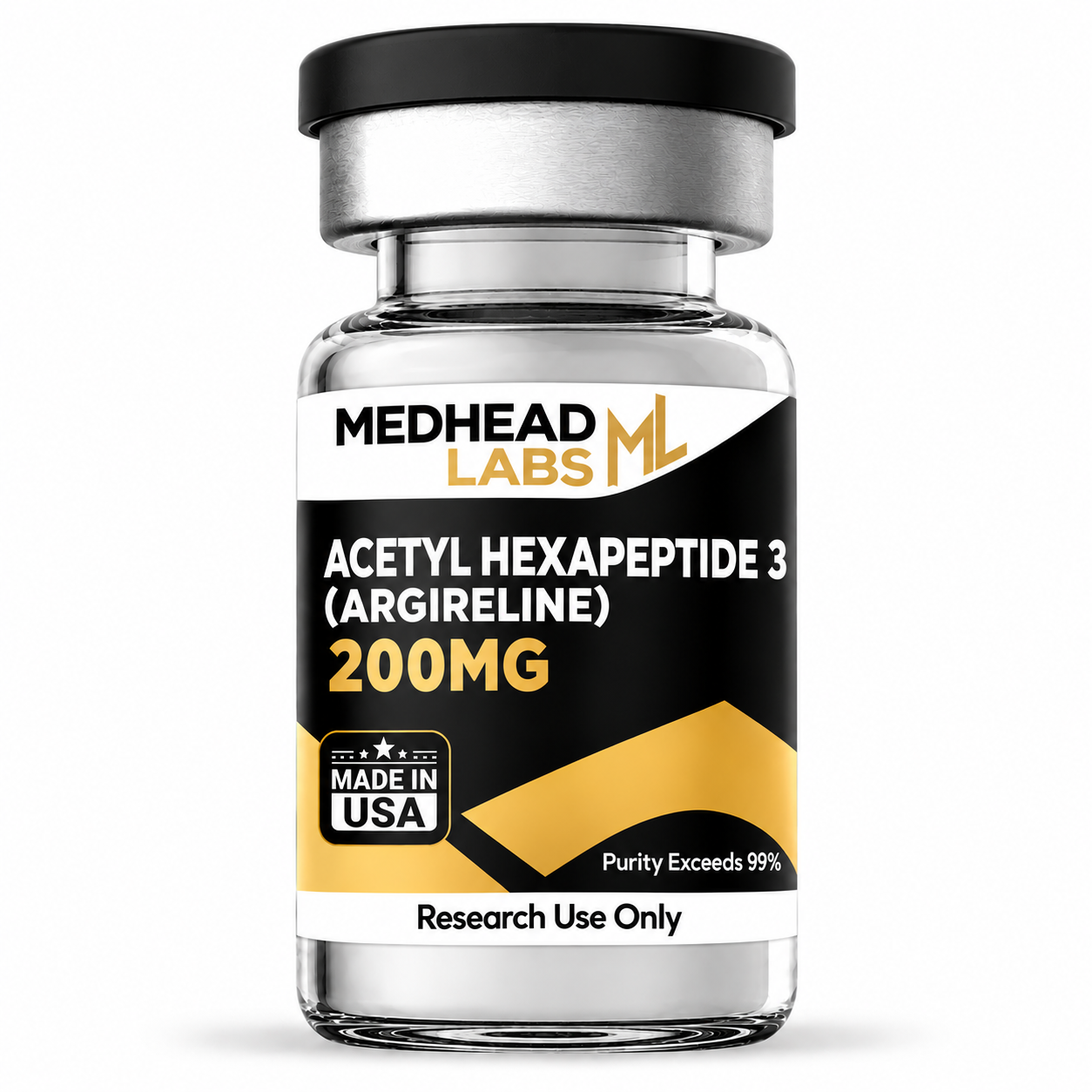

Acetyl Hexapeptide-3 (Argireline) (200 mg)
Acetyl Hexapeptide-3 (Argireline) (200 mg) is a synthetic peptide used in laboratory, biochemical, and cosmetic-science research. It has attracted research interest because of its relationship with molecular pathways involved in neurotransmitter release and facial-expression-related muscle activity.
This 200 mg research preparation is intended for qualified laboratory and research applications only. It is not intended to diagnose, treat, cure, or prevent any disease or medical condition.
Product Overview
Acetyl Hexapeptide-3 is a short synthetic peptide that has been investigated in biochemical and cosmetic-science research.
It is commonly associated with the trade name Argireline and has been studied in relation to molecular processes involving the SNARE protein complex and neurotransmitter release.
Product Information
| Specification | Details |
|---|---|
| Product | Acetyl Hexapeptide-3 (Argireline) |
| Amount | 200 mg |
| Category | Synthetic peptide |
| Research area | Peptide and cosmetic-science research |
| Intended use | Laboratory and research applications |
| Form | Research-grade preparation |
What Is Acetyl Hexapeptide-3?
Acetyl Hexapeptide-3 is a synthetic peptide composed of a short sequence of amino-acid residues. Researchers have investigated its molecular interactions and potential effects on pathways associated with neurotransmitter release.
Its research relevance is particularly strong within cosmetic science, where scientists have explored molecular mechanisms associated with facial muscle activity and expression-related skin changes.
Argireline is the commonly recognized trade name associated with this peptide.
How Does It Work?
Research has examined this peptide in connection with the SNARE protein complex, which plays an important role in vesicle fusion and neurotransmitter release.
Experimental studies have investigated whether the peptide can influence interactions between proteins involved in this process. This has made it useful as a subject for research into molecular signaling, muscle contraction, and cosmetic formulation science.
Results can vary depending on the experimental model, concentration, formulation, and laboratory conditions.
Research Applications
Potential research areas include:
- Peptide biochemistry
- Cosmetic-science research
- Skin biology
- Molecular interaction studies
- Protein-complex research
- Neurotransmitter-release research
- Formulation research
- Structure-activity relationship studies
Researchers can investigate peptide behavior using controlled laboratory models and appropriate analytical techniques.
Cosmetic-Science Research
Argireline has received attention in cosmetic research because scientists have investigated the relationship between facial muscle activity, neurotransmitter release, and expression-related skin changes.
Research in this field focuses on understanding molecular mechanisms rather than automatically establishing clinical effectiveness.
Laboratory findings should therefore be interpreted within the context of the specific experimental model in which they were obtained.
Key Characteristics
Important characteristics include:
- Synthetic peptide structure
- Short amino-acid sequence
- Research interest in molecular signaling
- Association with SNARE-related mechanisms
- Application in cosmetic-science research
- Use in peptide and formulation studies
Laboratory Research Considerations
Researchers using this material should establish appropriate experimental conditions according to their specific study design.
Important considerations may include:
- Sample identity
- Purity and analytical data
- Concentration
- Solubility
- Experimental model
- Storage conditions
- Handling procedures
- Compatibility with the research system
All laboratory work should be conducted using appropriate research procedures and safety practices.
Storage and Handling
Storage requirements should be determined from the supplier’s product documentation and certificate of analysis for the specific batch.
Appropriate laboratory handling practices should be followed to minimize contamination, degradation, and unnecessary exposure.
Research materials should only be used for their intended laboratory applications.
Frequently Asked Questions
What is Acetyl Hexapeptide-3?
It is a synthetic short-chain peptide studied in biochemical and cosmetic-science research, particularly in relation to molecular pathways associated with neurotransmitter release.
Is Acetyl Hexapeptide-3 the same as Argireline?
Argireline is the commonly used trade name associated with this peptide. Researchers should verify the identity and specifications of a particular product using its analytical documentation.
How much product is included?
This product contains 200 mg of material.
What is it used for in research?
Research applications can include peptide biochemistry, molecular interaction studies, cosmetic-science investigations, skin biology, and studies involving pathways associated with neurotransmitter release.
Is this product a medication?
No. A research-grade peptide should not be presented as a medication or as a treatment for a medical condition.
Can laboratory research results be considered clinical evidence?
No. Results from laboratory or experimental models cannot automatically be interpreted as evidence of safety or effectiveness in humans.
Why Choose Medhead Lab?
Medhead Lab provides research-focused peptide products intended for laboratory and scientific applications.
Researchers should review available product documentation, analytical information, storage requirements, and applicable regulations before using any research material.
Research-Use Disclaimer
For research and laboratory use only. Not for human consumption. Not intended to diagnose, treat, cure, or prevent any disease or medical condition.
Researchers are responsible for following appropriate laboratory procedures, safety requirements, product documentation, and applicable regulations.
Conclusion
Acetyl Hexapeptide-3 (Argireline) is a synthetic peptide that has been studied extensively in biochemical and cosmetic-science research. Its relationship with molecular mechanisms involved in neurotransmitter release has contributed to continued interest in peptide-protein interactions, facial-expression-related muscle activity, and cosmetic formulation research.
The 200 mg preparation is suitable for qualified laboratory investigations where controlled experimental conditions, appropriate handling, and analytical evaluation are required.
Product: Acetyl Hexapeptide-3 (Argireline)
Quantity: 200 mg
Application: Research and laboratory use
Be the first to review “Acetyl Hexapeptide 3 (Argireline) (200mg)”
Related products




Reviews
There are no reviews yet.